System upgrade reminder, Homepage update.
3D Printing materials
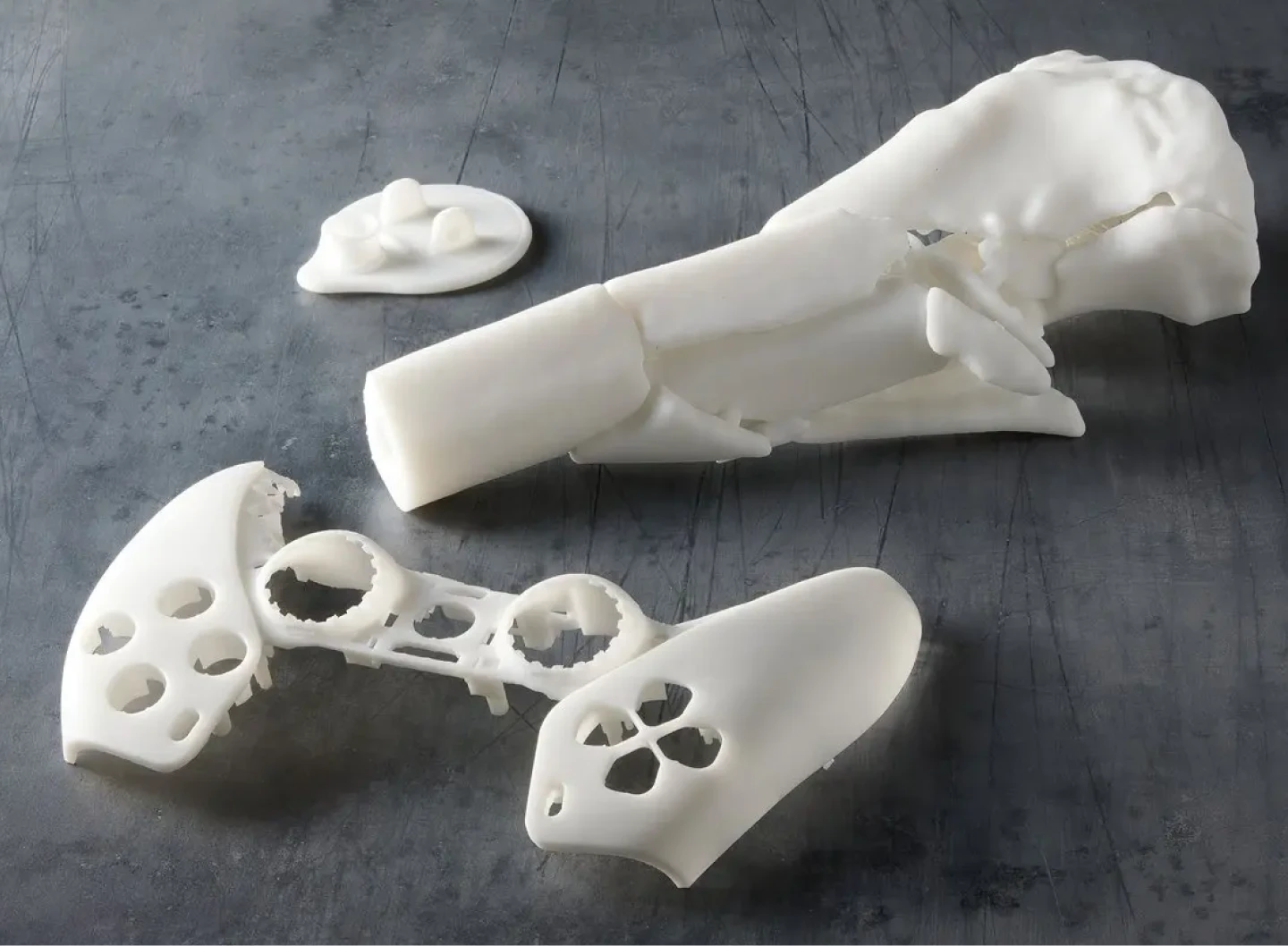
Photosensitive resin is a thermosetting material that solidifies when exposed to UV light. In 3D printing processes like SLA or DLP, a UV light source selectively cures liquid resin layer by layer—this is the core of vat photopolymerization. It achieves micron-scale accuracy, making it possible to rapidly produce 3 D parts with high precision, fine surface details, and complex designs that match the quality of injection molding
Get Instant QuoteSLA 3D printing uses a UV laser to cure liquid photopolymer resin point by point, forming precise layered structures. It achieves high dimensional accuracy, typically within ±0.04–±0.20 mm, and produces exceptionally smooth surfaces with nearly invisible layer lines. Although printing speed may decrease as cross-sectional size or structural complexity increases, SLA remains ideal for large, high-precision components. As the most mature vat photopolymerization technology, SLA is widely used for jewelry casting models, industrial prototypes, and high-precision functional parts.

Characteristic
★★☆☆☆
±0.1 – ±0.2 mm
0.4 – 0.6 mm
≥0.5 mm
≥0.2 mm

Description
SLA resin printing is suitable for prototypes or functional parts requiring visual presentation, ultra-high precision, complex structures, smooth surfaces.
Ultra-high precision, excellent detail, and surfaces quality comparable to injection molding.
Resin parts have relatively slow printing speeds and lower strength, stiffness, and heat resistance compared to engineering plastics like ABS or Nylon.
DLP 3D printing uses a projector to expose an entire cross‑section of photosensitive resin in a single pass, curing the whole layer simultaneously. This typically delivers faster print speeds than SLA. It is well‑suited for batch production of small parts and models with intricate details. Precision is high but limited by projector pixel density, and resolution per unit area can decrease on larger parts. Curved edges may show slight “stepping” from pixelation, which can be addressed with post‑processing.
Characteristic
★★★☆☆
±0.05 – ±0.1 mm
0.3 – 0.6 mm
≥0.4 mm
≥0.15 mm
Description
DLP resin printing is ideally suited for rapid batch production of small parts and intricate models due to its operating principle.
Fast print speeds enable batch production, with high precision and detail performance.
Compared to SLA, precision is limited by projector pixel resolution, and subtle layer lines may be visible.
Ready to start?
Select from our full range of materials for your application.
Due to its high versatility, exceptional whiteness, excellent detail resolution, and ease of printing, it is the most widely used general‑purpose material.
Black resin provides exceptional contrast that effectively conceals subtle layer lines from printing, giving products a premium look and feel.
Toughened resin offers mechanical properties comparable to engineering plastics like ABS, but at a lower cost.
Transparent resin delivers outstanding light transmittance and can achieve near glass-like clarity when polished or clear-coated.
Translucent resins diffuse light rather than transmit it, producing soft, even illumination. They are commonly used for lampshades, light guides, and designs requiring a hazy effect.
High heat resistance with a heat deflection temperature significantly higher than standard resins. Ideal for producing heat-resistant molds and functional parts for high-temperature baking environments.
It is commonly used in the production of investment casting models, thermoforming mold cores, and applications requiring short-term high-temperature resistance.

Building A, Jinsheng Finance Building, No. 217 Nanhuan Road, Bao'an District.
MAKE DIRECT HOLDINGS LIMITED Unit 1111, 11/F, Hollywood Plaza, 610 Nathan Road, Mong Kok, Kowloon, Hong Kong