System upgrade reminder, Homepage update.
3D Printing materials
Nylon (Polyamide/PA) offers exceptional mechanical properties, high chemical and wear resistance, and excellent capability for forming complex geometries. It is a lightweight material that is well-suited for post-processing. These qualities make it a preferred thermoplastic for applications that traditionally rely on injection-molded functional parts.
Get Instant QuoteSLS 3D printing uses a high-power laser to selectively fuse nylon powder layer by layer, while unsintered powder naturally supports complex geometries. The process achieves high precision (±0.1–±0.3 mm) and can reproduce fine details, supporting wall thicknesses as low as 0.5 mm. It is widely used for prototypes and functional parts with complex internal structures, producing strong end-use components efficiently for small-batch production.

Characteristic
★★★☆☆
±0.2 – ±0.3 mm
≥0.7 mm
≥1.0 mm
≥0.5 mm
≥0.5 mm

Description
Ideal for manufacturing functional prototypes and end-use parts that are high in toughness, wear-resistant, and chemically resistant.
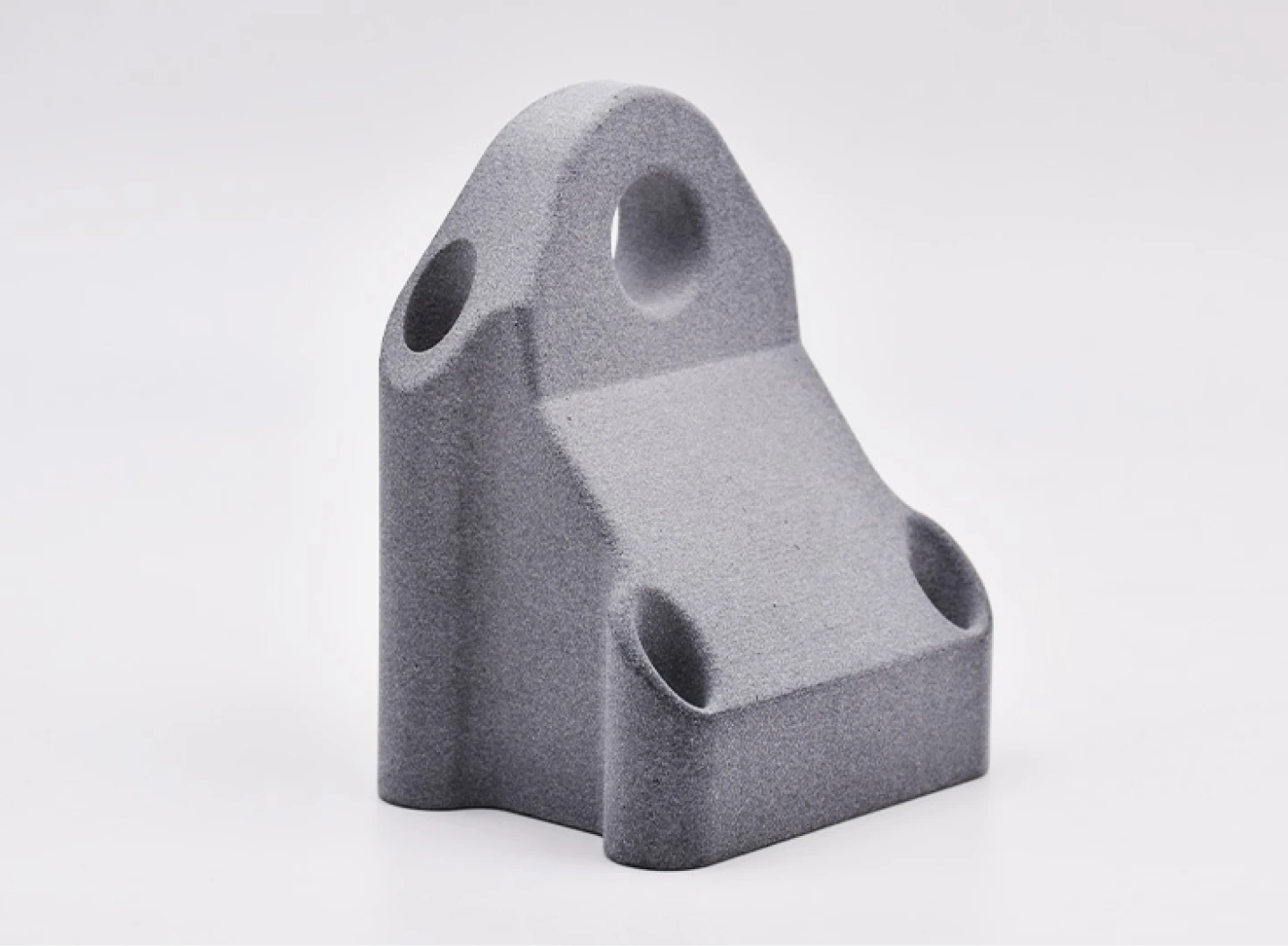
SLS Nylon 3D printing offers balanced mechanical properties and requires no support structures during printing. It achieves high material efficiency, with utilization rates up to 99%.
Parts have a matte surface that may require post-processing. The process requires humidity control (≤40%), and PA12 offers limited heat resistance (~150 °C); very large parts may experience slight dimensional deviations.
The working principle of MJF 3D printing involves an inkjet printhead selectively depositing a fusing agent and a detailing agent onto a bed of nylon powder. Infrared heating then fuses the powder layer by layer, with unsintered powder naturally supporting complex shapes. MJF provides high dimensional accuracy and fine detail, making it ideal for producing integrated, high-surface-quality, and precise functional parts and end-use products. Printing speed is high and scales with part size and batch density, typically reaching 5–8 L/h (2–3 times faster than SLS), delivering strong mass production efficiency for fast-turnaround small to medium batches.
Characteristic
★★★☆☆
±0.2 mm or ±0.2%
≥0.7 mm
≥1.0 mm
≥0.5 mm
Description
Ideal for producing functional prototypes and end-use parts that require high surface accuracy, strong mechanical properties, and excellent chemical resistance.
Excellent mechanical properties, no support structures required, smooth surface finish, powder recovery rate up to 96%, high production efficiency, capable of producing complex geometries.
Strict environmental control requirements (temperature 20-25°C / humidity 29-40%), with relatively higher costs compared to SLA or FDM.
Ready to start?
Select from our full range of materials for your application.
Nylon PA12-Solid White offers superior mechanical properties and chemical resistance. Its white nylon finish features a matte white appearance with a premium, refined texture that highlights structural details for easy defect detection.
SLS Nylon PA 12-Dyed Black maintains the same mechanical properties and chemical resistance as the white version, while providing better flaw concealment, improved oxidation resistance, and no risk of pigment migration.
HP Nylon & Glass Fiber-Dyed Black is a material made specifically for the MJF process. It combines high toughness with glass fiber rigidity, offering great mechanical properties and chemical resistance.
HP Nylon & Glass Fiber – Solid Gray is an MJF material with excellent strength, chemical resistance, and added rigidity from glass fiber. Its light gray matte surface improves visibility of part details and defects during inspection.
HP MJF base nylon offers higher heat resistance and strength than standard PA12, with excellent chemical resistance. Its light gray surface aids defect detection and supports complex functional parts.
HP MJF pre-dyed black nylon offers improved strength and chemical resistance over standard PA12. Its matte black finish resists fingerprints, blocks UV, and hides surface defects.

Building A, Jinsheng Finance Building, No. 217 Nanhuan Road, Bao'an District.
MAKE DIRECT HOLDINGS LIMITED Unit 1111, 11/F, Hollywood Plaza, 610 Nathan Road, Mong Kok, Kowloon, Hong Kong